
 Email Marketing
Many businesses in Kenya spend money generating leads but rarely follow up with the prospects they've already attracted. Learn how email marketing helps you nurture customer relationships, increase repeat sales, improve customer retention, and turn your email list into a consistent source of business growth.
Email Marketing in Kenya: How to Turn Your Email List into a Consistent Source of Leads, Sales and Customer Retention
Has your business invested time and money building an email list that rarely gets used?
If so, you're sitting on revenue you haven't tapped into yet.
Every day, businesses across Kenya invest in websites, Google Ads, social media marketing, exhibitions, networking events, and other lead generation activities to attract potential customers. Along the way, they collect valuable customer data through website contact forms, quotation requests, newsletter sign-ups, online purchases, consultations, event registrations, and other customer touchpoints.
In most cases, the information collected includes email addresses and phone numbers.
The problem is that many businesses never use this data strategically.
Instead, these contacts are stored in spreadsheets, CRMs, or email marketing platforms while the business focuses on finding the next lead. Yet these are the same prospects and customers who have already shown interest in your products or services.
Whether it's a property buyer who requested information about a development, an HR manager who downloaded your training catalogue, a business owner who requested a quotation, or a customer who purchased from your online store, every contact in your database represents an opportunity to build a relationship and generate future revenue.
If this sounds familiar, you're not alone.
We've worked with businesses across real estate, ecommerce, healthcare, logistics, and professional services that were collecting valuable customer data but lacked a strategy for nurturing prospects, generating repeat business, and maximizing customer lifetime value.
The truth is that your email list is more than a database.
It's one of the most valuable business assets you own.
When used strategically, email marketing allows you to stay connected with prospects, build trust, increase customer retention, generate repeat sales, and create a predictable pipeline of business opportunities.
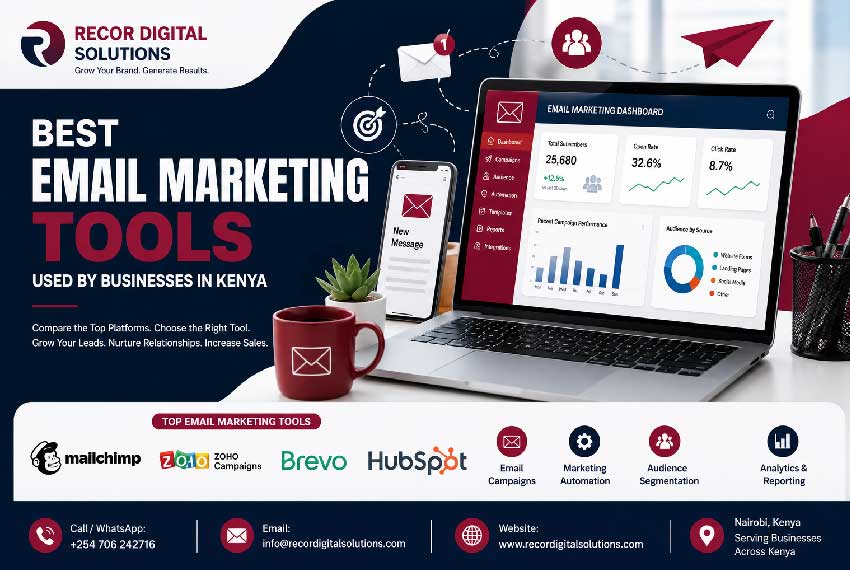
In this guide, you'll learn how to transform your email database into a consistent source of enquiries, sales, customer retention, and long-term business growth. You'll also discover practical email marketing strategies, automation techniques, and tools such as Mailchimp, Zoho Campaigns, and Brevo that can help you build stronger customer relationships, improve engagement, and unlock more value from the customer data you already have.
Understanding Email Marketing and How to Implement It in Your Business
What’s Email marketing
Email marketing is a digital marketing strategy that uses email to communicate with prospects and customers, build relationships, promote products or services, nurture leads, and encourage repeat business. It enables businesses to deliver personalized messages directly to people who have already shown interest in what they offer.
For businesses in Kenya, email marketing provides an opportunity to build lasting relationships with the prospects and customers you've already invested time and money to attract.
What advantage do you have with email marketing as a business
Unlike social media, where your content competes with thousands of other posts, or paid advertising, where visibility ends when your budget runs out, email marketing gives your business direct access to your audience.
Whether it's a potential client who requested a quotation, a property buyer who downloaded a brochure, an HR manager who registered for a webinar, or a customer who purchased from your online store, email allows you to continue the conversation long after the first interaction.
Instead of constantly spending money to generate new enquiries, you can nurture the relationships you've already started. You can educate prospects, answer common questions, share industry insights, promote relevant products or services, and stay top of mind until they're ready to make a purchasing decision.
For businesses across industries such as real estate, law, logistics, healthcare, ecommerce, furniture, and corporate training, email marketing has become one of the most cost-effective ways to nurture prospects, increase customer retention, generate repeat sales, and strengthen customer relationships.
When Should Your Business Start Using Email Marketing?
The best time to implement email marketing is the moment your business starts collecting customer information.
If you're already receiving enquiries through your website, generating leads from Google Ads or social media, collecting contacts at exhibitions, processing online orders, or managing customer information in your CRM, you already have the foundation for an effective email marketing strategy.
One of the biggest misconceptions is that you need thousands of contacts before email marketing becomes worthwhile.
The reality is quite different. A database of 300 engaged prospects who regularly receive valuable, relevant emails will often outperform a list of 10,000 contacts that never hears from your business. The earlier you begin building relationships through email, the easier it becomes to earn trust, stay relevant, and convert prospects into loyal customers.
Key Business Takeaway
Email marketing is about building stronger relationships with the prospects and customers your business has already worked hard and often paid to attract. Every email should have a purpose, whether it's educating your audience, answering their questions, introducing a solution, or encouraging the next step in their buying journey.
When implemented strategically, email marketing becomes one of the most effective ways to generate more enquiries, increase customer retention, and maximize the return on your overall marketing investment.
How Email Marketing Works
Email marketing is a structured process that helps you build relationships with potential customers from their very first interaction with your business until they become loyal customers and even advocates for your brand.
Every successful email marketing strategy follows a customer journey. The goal is to deliver the right message at the right time based on where your prospect or customer is in their buying journey.
What a typical email marketing journey looks like.
Step 1: A Potential Customer Discovers Your Business
Every email marketing journey begins with a prospect showing interest in your business.
It could be a property buyer searching for homes in Nairobi, an HR manager looking for corporate training programmes, a business owner requesting a quotation, or an online shopper browsing products on your ecommerce store.
At this stage, your website, Google Ads, SEO, social media marketing, referrals, or networking events have already done their job by attracting the right audience.
Step 2: You Collect Their Contact Information
The next step is turning that interest into an opportunity for future engagement.
This usually happens when a potential customer completes one of the following;
- Fills contact form on your website.
- Requests a quotation.
- Downloads a company profile, brochure, or buying guide.
- Registers for a webinar or event.
- Subscribes to your newsletter.
- Makes an online purchase.
- Books a consultation.
Once they share their email address, you've earned permission to continue the conversation.
Step 3: Send a Welcome Email
Your first email is often the most important. Instead of immediately trying to make a sale, welcome your new subscriber, thank them for their interest, and let them know what they can expect from your emails.
A strong first impression helps build trust and increases the likelihood that future emails will be opened and read.
Step 4: Nurture the Relationship with Valuable Content
Most people won't make a buying decision after a single interaction. That's why successful businesses use email to educate, inform, and build credibility over time. Depending on your industry, you might share:
· Property buying tips with prospective homebuyers.
· Legal insights that answer common client questions.
· Corporate training resources for HR managers.
· Product guides and design inspiration for homeowners.
· Industry updates and practical advice for business owners.
Every email should move the relationship forward by providing genuine value and not just promoting your services.
Step 5: Encourage the Next Step
As trust grows, your emails should guide prospects towards taking action.
This could include:
- Booking a consultation.
- Requesting a quotation.
- Scheduling a property viewing.
- Purchasing a product.
- Registering for a training programme.
- Speaking to your sales team.
Because you've already built credibility through previous emails, prospects are more likely to engage when the opportunity is relevant to their needs.
Step 6: Continue the Relationship After the Sale
Email marketing doesn't end once a customer makes a purchase. In fact, this is where many businesses miss valuable opportunities.
After a sale, continue engaging customers by sending onboarding information, helpful resources, product recommendations, customer support tips, feedback surveys, renewal reminders, or exclusive offers.
These ongoing interactions strengthen customer relationships and encourage repeat business.
Step 7: Turn Satisfied Customers into Repeat Buyers and Referrals
A satisfied customer is one of your greatest marketing assets. By staying in touch through valuable and relevant email communication, you increase the likelihood of repeat purchases, contract renewals, referrals, and positive recommendations.
Over time, email marketing becomes more than a communication tool, it becomes a long-term customer retention strategy that supports sustainable business growth.