
 Email Marketing
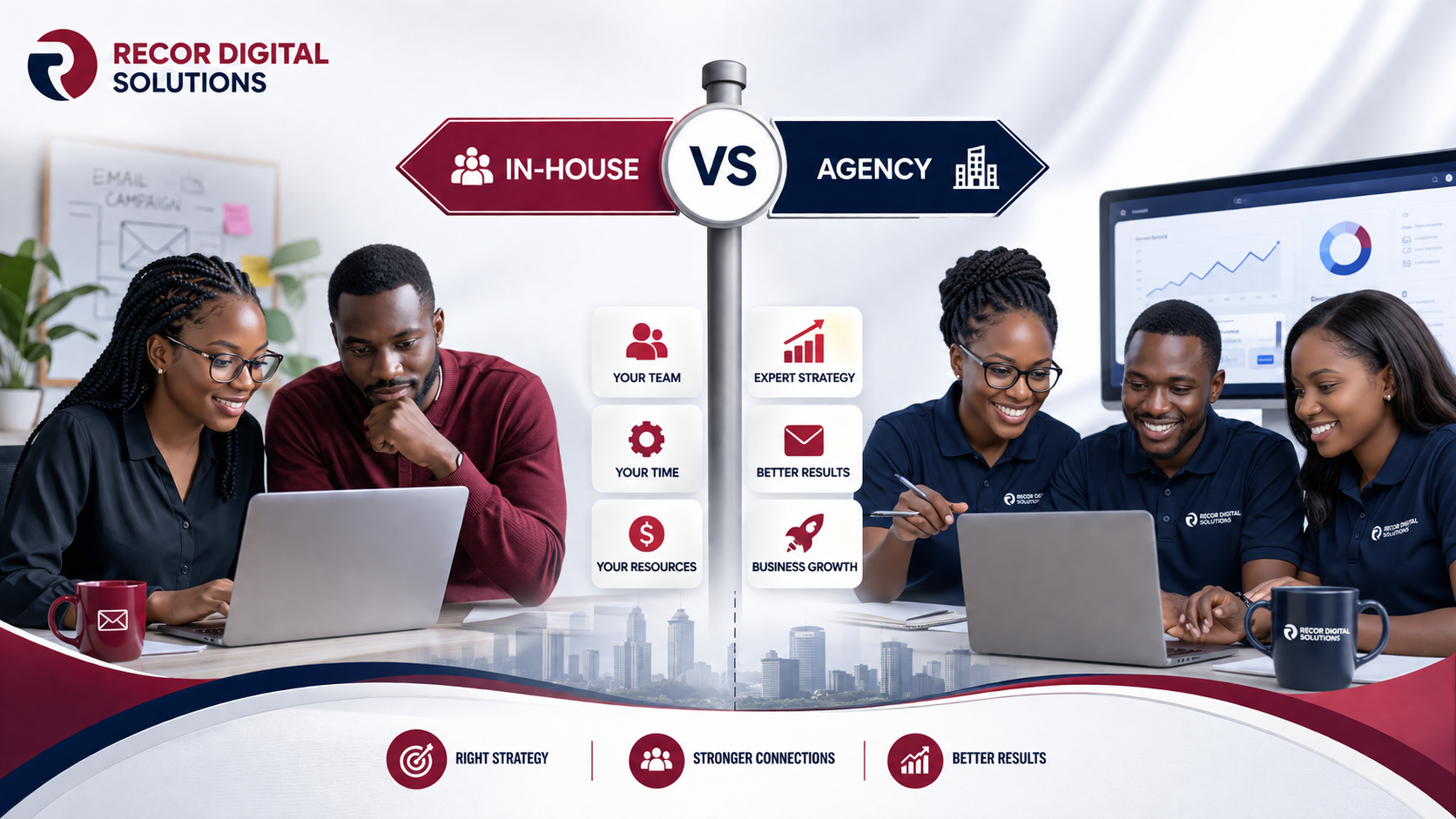
Should your business build an internal email marketing team or work with an experienced agency? The right choice depends on your business goals, available resources, marketing expertise, and growth plans. In this guide, we compare the advantages, challenges, costs, scalability, and long-term value of both approaches. You'll also find answers to the most common email marketing questions Kenyan businesses ask before investing in email marketing, automation, customer retention, and lead nurturing.
Investing in email marketing is very key for business looking to maintain consistent customer engagement, build relationships and maintain consistent and repetitive revenue. Deciding on whether to manage email marketing inhouse or hire a professional agency narrows down to your business goals, available resources, marketing expertise, and the level of sophistication you want from your campaigns.
Managing Email Marketing In-House
Managing email marketing internally means your employees are responsible for planning campaigns, creating content, designing emails, segmenting audiences, building automation workflows, monitoring performance, and continuously improving results.
This approach gives your business complete control over its email marketing activities and allows your team to work closely with other departments such as sales and customer service.
Advantages of Managing Email Marketing In-House
✔ Complete control over campaigns and customer communication.
✔ Faster collaboration with internal departments.
✔ Deep understanding of your products, services, and company culture.
✔ Immediate access to customer information and business updates.
For businesses with experienced marketing professionals and dedicated resources, managing email marketing internally can be highly effective.
Challenges of Managing Email Marketing In-House
Email marketing involves much more than sending newsletters.
Successful campaigns require expertise in:
- Email strategy
- Copywriting
- Graphic design
- Audience segmentation
- Marketing automation
- CRM integration
- Deliverability optimization
- Campaign analytics
- A/B testing
- Compliance with email marketing best practices
Building these capabilities internally often requires significant investment in recruitment, training, software, and ongoing professional development.
Hiring an Email Marketing Agency
An email marketing agency provides a dedicated team of specialists responsible for planning, implementing, optimizing, and reporting on your campaigns.
Instead of relying on one employee with multiple responsibilities, your business benefits from professionals with expertise across strategy, design, automation, analytics, and conversion optimization.
For many businesses in Kenya, this approach provides faster results while allowing internal teams to focus on serving customers and growing the business.
Advantages of Working with an Agency
✔ Access to experienced email marketing specialists.
✔ Professional campaign strategy and planning.
✔ High-quality email copywriting and design.
✔ Advanced automation and customer journey development.
✔ Better audience segmentation and personalization.
✔ Performance monitoring and continuous optimization.
✔ Access to industry-leading email marketing tools.
✔ Regular reporting and measurable business insights.
An experienced agency also works across multiple industries, bringing proven ideas and best practices that have already delivered results for other businesses.
Challenges of Working with an Agency
Working with an agency requires choosing the right partner.
Your agency should invest time in understanding your business, customers, industry, and objectives rather than sending generic email campaigns.
The most successful agency relationships are built on collaboration, clear communication, and measurable business outcomes.
In-House vs Agency Comparison
|
Factor |
In-House Team |
Email Marketing Agency |
|
Initial Cost |
Recruitment, salaries, software and training |
Monthly management fee |
|
Expertise |
Depends on internal experience |
Access to specialists across multiple disciplines |
|
Campaign Strategy |
Limited by internal knowledge |
Built using industry best practices |
|
Marketing Automation |
May require additional training |
Usually included |
|
Email Design & Copywriting |
Internal resources required |
Managed by experienced specialists |
|
Reporting & Analytics |
Depends on available skills |
Comprehensive performance reporting |
|
Scalability |
Requires hiring more staff |
Easily scales as your business grows |
|
Technology |
Business purchases and manages software |
Agency often manages implementation and optimization |
|
Time Commitment |
High |
Low for your internal team |
Key Business Takeaway
There is no one-size-fits-all approach to email marketing. The right decision depends on your business goals, available resources, and the level of expertise required to achieve consistent results.
While some organizations successfully manage email marketing internally, many businesses achieve faster growth by partnering with an experienced agency that brings strategic planning, automation expertise, campaign optimization, and continuous performance improvement.
Whichever approach you choose, the objective remains the same: building stronger customer relationships, generating qualified enquiries, increasing repeat business, and maximizing the value of your email database.
Frequently Asked Questions (FAQs) About Email Marketing in Kenya
1. Is Email Marketing Still Effective for Businesses in Kenya?
Yes. Email marketing remains one of the most effective digital marketing channels because it allows businesses to communicate directly with prospects and customers who have already shown interest in their products or services. Unlike social media, where algorithms determine who sees your content, email gives your business direct access to your audience.
When implemented strategically, email marketing helps businesses generate qualified enquiries, nurture leads, increase repeat purchases, improve customer retention, and maximize customer lifetime value.
2. How Much Does Email Marketing Cost in Kenya?
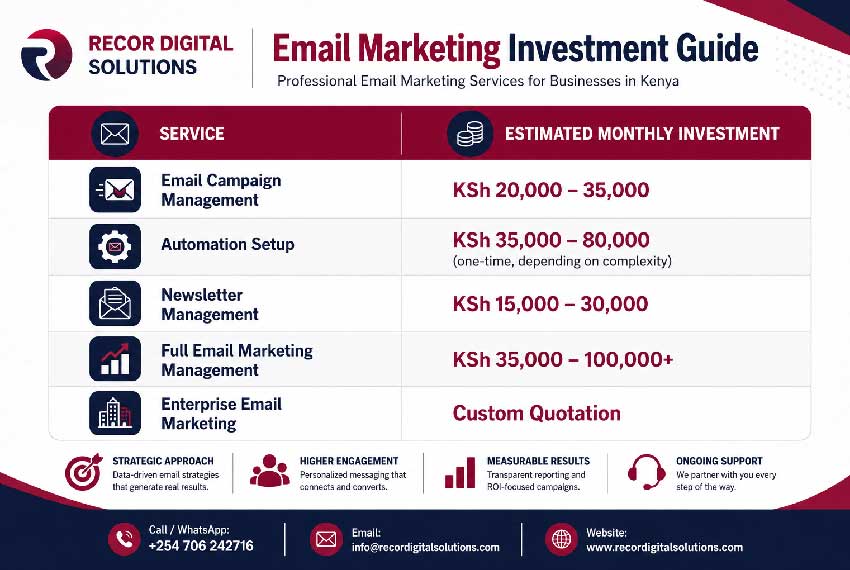
The cost of email marketing in Kenya typically ranges between KSh 15,000 and KSh 100,000+, depending on the services required.
The investment usually depends on factors such as:
- Size of your email database
- Number of campaigns each month
- Email automation requirements
- Customer segmentation
- CRM integration
- Campaign management
- Reporting and optimization
Businesses with more advanced automation and customer journeys generally require a larger investment than those sending occasional newsletters.
3. When Should My Business Start Email Marketing?
The best time to start is as soon as your business begins collecting customer information.
If your business already receives enquiries through your website, Google Ads, social media, exhibitions, referrals, or online purchases, you already have the foundation for email marketing.
Starting early allows you to build relationships with prospects before they purchase and continue engaging customers long after the sale.
4. Which Businesses Benefit Most from Email Marketing?
Almost every industry can benefit from email marketing.
In Kenya, it is particularly effective for:
- Real estate companies
- Ecommerce businesses
- Healthcare providers
- Law firms
- Corporate training providers
- Logistics companies
- Manufacturers
- Schools and universities
- Furniture and home décor businesses
- Financial and professional service firms
Any business that collects customer information can use email marketing to nurture relationships and generate more revenue.
5. What Is the Best Email Marketing Platform?
There isn't a single platform that's best for every business.
The right platform depends on your objectives, budget, team, and customer journey.
Some of the most popular platforms include:
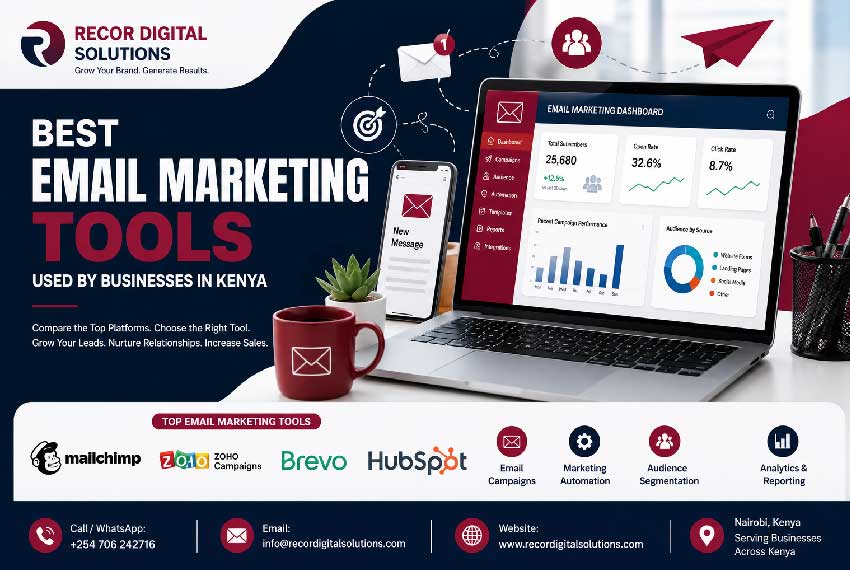
- Mailchimp
- Zoho Campaigns
- Brevo
- HubSpot
Each platform offers different strengths in automation, CRM integration, customer segmentation, reporting, and scalability.
6. How Often Should My Business Send Marketing Emails?
There is no universal schedule. The ideal frequency depends on your industry, audience, and content strategy.
For many businesses, sending one to four valuable emails each month is enough to stay visible without overwhelming subscribers.
The focus should always be on providing relevant content rather than simply increasing email volume.
7. Can Email Marketing Work with Google Ads and SEO?
Absolutely. Email marketing performs best when integrated with your broader digital marketing strategy.
For example:
- Google Ads generates qualified enquiries.
- Your website captures email addresses.
- Email automation nurtures prospects.
- SEO attracts long-term organic traffic.
Email campaigns encourage repeat purchases and referrals.
Together, these channels create a complete customer acquisition and retention strategy.
8. How Long Does It Take to See Results from Email Marketing?
Some results can be seen immediately. For example, welcome emails, quotation follow-ups, abandoned cart reminders, and promotional campaigns often generate engagement within hours or days.
Long-term benefits such as stronger customer relationships, improved retention, increased repeat purchases, and higher customer lifetime value develop over several months of consistent communication.
9. Is Buying an Email List a Good Idea?
No. Purchased email lists often contain contacts who have never interacted with your business or given permission to receive marketing emails.
This can lead to:
Low engagement
Higher unsubscribe rates
Spam complaints
Poor email deliverability
Damaged sender reputation
Building your own permission-based email list consistently delivers better engagement and stronger long-term business results.
10. What Is the Biggest Mistake Businesses Make with Email Marketing?
The biggest mistake is collecting customer email addresses but failing to use them consistently.
Many businesses invest heavily in generating leads through Google Ads, SEO, social media, networking events, and referrals, only to stop communicating after the first interaction.
Successful businesses use email marketing to continue educating prospects, answering questions, building trust, encouraging repeat purchases, and maintaining long-term customer relationships.